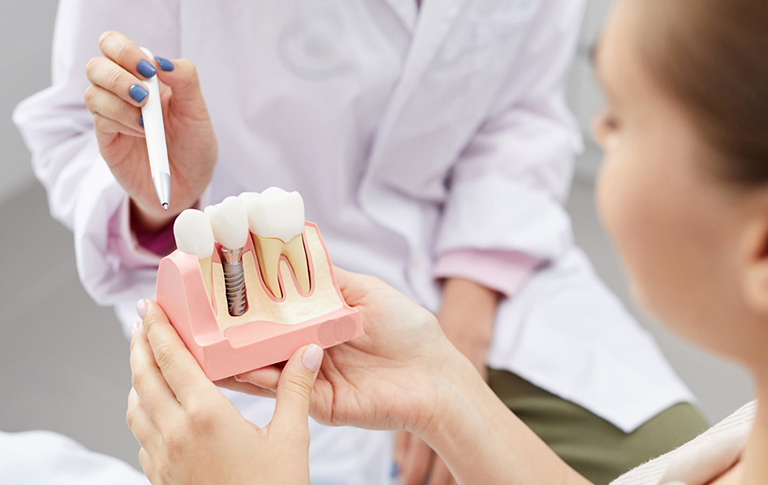

Dental implants are a fixed option for replacing one or more missing teeth. They are designed to restore function and appearance by replacing both the tooth root and the visible tooth above the gum line.
At East Coast Bays Dental, dental implants are considered part of a long-term restorative plan. Suitability is assessed carefully, with a focus on oral health, comfort, and achieving a stable, functional result that feels as natural as possible.
A dental implant consists of a small titanium screw that is placed into the jawbone to act as an artificial tooth root. Once the implant has healed and integrated with the bone, a replacement tooth is attached on top.
A tooth implant is fixed in place and cannot be removed by the patient. Dental implants may be used to replace a single missing tooth, multiple missing teeth using an implant bridge, or a full arch of teeth using implant-supported dentures. The most appropriate option depends on your oral health, bone structure, and overall treatment goals.
Dental implants may be recommended if a tooth has been lost due to decay, injury, gum disease, or extraction, particularly when a fixed, long-term replacement is preferred.
Your dentist will assess factors such as bone health, gum condition, bite, and general oral health before discussing whether dental implants are suitable. For appropriate patients, implants can provide stable tooth replacement, support comfortable chewing and speech, help maintain jawbone structure, and avoid relying on neighbouring teeth for support. Alternative options such as bridges or dentures may also be discussed so you can make an informed decision.
The dental implant process usually takes place over several stages and may span several months.
Initially, your dentist will carry out a detailed assessment, which may include scans or imaging to evaluate bone levels and plan implant placement. If suitable, the implant is placed into the bone under local anaesthetic. A healing period then allows the implant to integrate with the bone before a custom-made replacement tooth, bridge, or denture is attached.
Caring for dental implants involves the same principles as caring for natural teeth, including good oral hygiene and regular dental check-ups. Ongoing maintenance supports the long-term success of implant treatment, and personalised advice is provided as part of your care.